
Don’t assume logging in is the hard part: how OKX account, futures, and wallet actually work — and where they break
Common misconception: signing into an exchange is a simple password-and-click chore and everything that follows is just “trading.” In practice, the login, custody model, and product design set the operational constraints for every trade you will make — especially on platforms like OKX that combine centralized exchange services, derivatives, and a non‑custodial Web3 wallet. This piece unpacks the mechanics, trade-offs, and practical limits U.S. traders should know when they log into an OKX account, use OKX futures, or interact with the OKX wallet.
The goal is not to sell the platform but to make its architecture visible: how account protection, Proof of Reserves, custody choices, and product limits shape outcomes. I’ll explain how things work, where the surprises are, and give simple heuristics you can reuse next time you decide whether to custody on‑exchange, move assets to the wallet, or size a leveraged futures position.
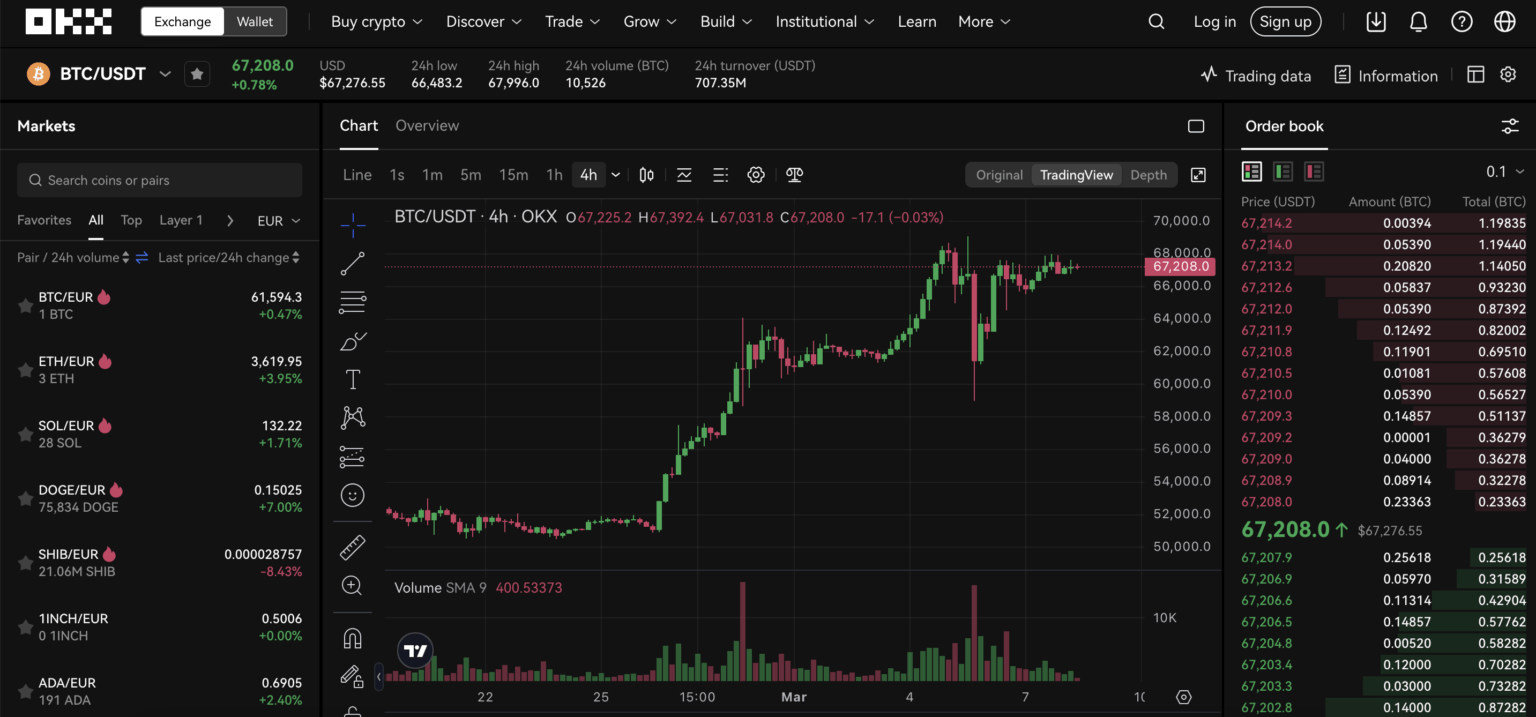
How OKX treats identity, login, and account protection — mechanisms and limits
Mechanism: OKX combines a centralized account model with strong technical protections. Accounts are protected by military‑grade encryption on the backend, mandatory two‑factor authentication (2FA) (SMS, Google Authenticator, or biometrics on mobile), and AI‑driven real‑time threat detection that flags unusual login attempts. On top of that, OKX performs KYC (Know Your Customer) identity verification for account creation: users in regulated jurisdictions such as the U.S. must submit government ID and complete a facial liveness check.
Why that matters: those mechanisms reduce account‑takeover risk and allow OKX to offer services that require regulatory compliance (fiat rails, derivatives). But security is layered, not absolute. The strongest server encryption doesn’t protect you from phishing pages, SIM swaps on SMS 2FA, or a compromised local device. Similarly, KYC reduces anonymous fraud but increases dependency on centralized identity records — which raises its own privacy and lockout risks.
Practical rule: treat login protection as necessary but insufficient. Use hardware-enabled 2FA (Authenticator apps or biometrics where available), avoid SMS when possible, and consider a separate device dedicated to high‑value account management. If you need the direct link to OKX’s web login flow, use the verified route: okx login.
Custody spectrum: exchange accounts vs. the OKX Web3 wallet
Mechanism: OKX operates both as a centralized custodian (CEX) for deposited assets and as a provider of a self‑custodial Web3 wallet. On the custodian side, OKX stores over 95% of user assets in cold, air‑gapped, multi‑signature wallets. They also publish Proof of Reserves (PoR) on‑chain so users can verify the exchange backs deposits. On the self‑custodial side, the OKX wallet gives you a seed phrase, supports hardware integrations (Ledger, Trezor), and connects to thousands of dApps.
Trade-off and limit: custodial convenience vs. absolute control. Keeping funds on exchange enables instant trading, margin, and futures without on‑chain transfers — and benefits from PoR transparency and institutional controls. But exchange custody places trust in the platform’s security processes and legal jurisdiction. The non‑custodial wallet removes custody risk from the exchange, but then you alone are responsible for the seed phrase. Lose it and access is permanently gone.
Heuristic: short-term trading capital and margin collateral often belongs on the CEX for speed; large, longer‑term holdings, NFTs, and DeFi positions you plan to use externally are generally safer in self‑custody with hardware backups. Rebalance frequency and your ability to recover keys should determine the split, not convenience alone.
OKX futures and derivatives — leverage mechanics and the real risks
Mechanism: OKX offers a continuum of derivatives: options, quarterly futures, and perpetual swaps with up to 125x leverage on specific assets. Margin can be isolated or cross, and margin multipliers vary by asset and account tier. Perpetuals use funding payments to anchor prices to spot. Liquidation is automatic when maintenance margin is breached.
Where traders are surprised: leverage multiplies not only returns but also the platform‑specific fragilities — slippage on low liquidity, funding spikes, and liquidation cascades. High leverage (say 50x+) is effectively a bet that short‑term volatility will be low; on a platform that supports many low‑volume assets, the bid‑ask spread and order book depth can change rapidly, making execution and liquidation outcomes unstable.
Limitations and risk management: advanced options and 125x products increase tail‑risk. For U.S. traders, assess three constraints before opening a leveraged position: the asset’s order book depth, how quickly you can add margin, and whether your account uses cross or isolated margin. Simple rule: restrict leverage to levels where a realistic price move over your target timeframe would not trigger liquidation unless you accept that outcome.
Interacting with DeFi, staking, and the DEX aggregator — opportunities and attack surfaces
Mechanism: OKX supports over 130 native blockchains and 300+ assets, includes DeFi yield options (flexible staking, lock‑ups, auto‑compounding), and has a DEX aggregator that sources liquidity across major DEXs to optimize swap routes and enable cross‑chain transfers. This makes it possible to move between centralized markets, NFTs, and Web3 dApps within one interface.
Trade-off: convenience vs. composability risk. Integrated staking/yield and an NFT marketplace with creator royalties are powerful, but interacting with DeFi protocol code and bridges introduces smart contract risk. OKX can reduce counterparty risk when assets are custodied, yet once you route funds through yield protocols or bridges, platform guarantees don’t cover smart contract failures or exploit vectors.
Practical precaution: when using yield farming or cross‑chain bridges, prefer small value testing, time‑limited lockups, and transparent projects with audited contracts. Use the OKX DEX aggregator for routing efficiency, but treat cross‑chain transfers as operationally more fragile than simple exchange trades.
Where Proof of Reserves helps — and where it doesn’t
Mechanism: OKX publishes Proof of Reserves that allow on‑chain verification the exchange holds assets at least equal to its liabilities. This is a transparency mechanism, not an insurance policy. It can detect insolvency signals and reassure users about aggregate backing.
Limitations: PoR does not protect individual account actions, it does not prevent operational errors (e.g., processing errors, wrongful freezes), and it doesn’t eliminate the need for robust internal controls. PoR is a snapshot-style assurance: it’s useful but not comprehensive.
Decision heuristic: use PoR as one input in counterparty assessment — good to see, required to trust large custodial balances — but still diversify custody, insure where possible, and retain operational readiness to move funds if alarms appear.
FAQ
Q: Is OKX legal for U.S. traders and what restrictions should I expect?
A: OKX operates with a KYC process aligned to AML rules; U.S. users must complete identity verification and follow local regulations. Some products or listings may be restricted in certain states due to securities or derivatives rules. Always check product availability in your state and read the terms before trading derivatives.
Q: Should I keep assets on the OKX exchange or in the OKX Web3 wallet?
A: Use a split approach: keep capital needed for active trading and margin on the exchange, while larger long‑term holdings and assets you plan to use in external dApps belong in self‑custody with a hardware backup. Treat the wallet seed phrase as the single‑point‑of‑failure for non‑custodial funds.
Q: What is the practical difference between margin and futures on OKX?
A: Margin trading borrows funds to amplify spot positions (up to about 10x), while futures and perpetual swaps are derivative contracts that let you take exposure without owning the underlying asset and can reach much higher leverage (up to 125x on select markets). Futures involve funding mechanics, expiration (for quarterly), and different liquidation behaviors compared to margin.
Q: How do I reduce the risk of phishing or account takeover?
A: Use authenticator apps or hardware 2FA instead of SMS, enable withdrawal whitelists, use unique passwords and a password manager, avoid clicking links in unsolicited messages, and confirm site URLs before logging in. Consider a separate device with minimal software for high‑value account actions.
What to watch next: in the short term, expect further convergence between CEX convenience and Web3 composability — more cross‑chain tooling, deeper DEX aggregation, and usability improvements for hardware wallets inside exchange flows. But watch regulatory signals in the U.S.: changes to derivatives oversight, stablecoin policy, or KYC requirements could directly affect product availability and how exchanges manage custody. These are conditional scenarios — they depend on regulatory choices and market adoption — but they are the right kind of signals to follow if you trade actively.
Final takeaway: signing in is only the first control in a chain of mechanisms that determine your outcomes. Treat login hygiene, custody choice, and product selection as linked decisions. Use account protection tools, understand the leverage and liquidity mechanics of futures, and separate funds by function (trading, staking, long‑term holding). With that mental model, logging into OKX becomes a deliberate operational step, not an afterthought.